
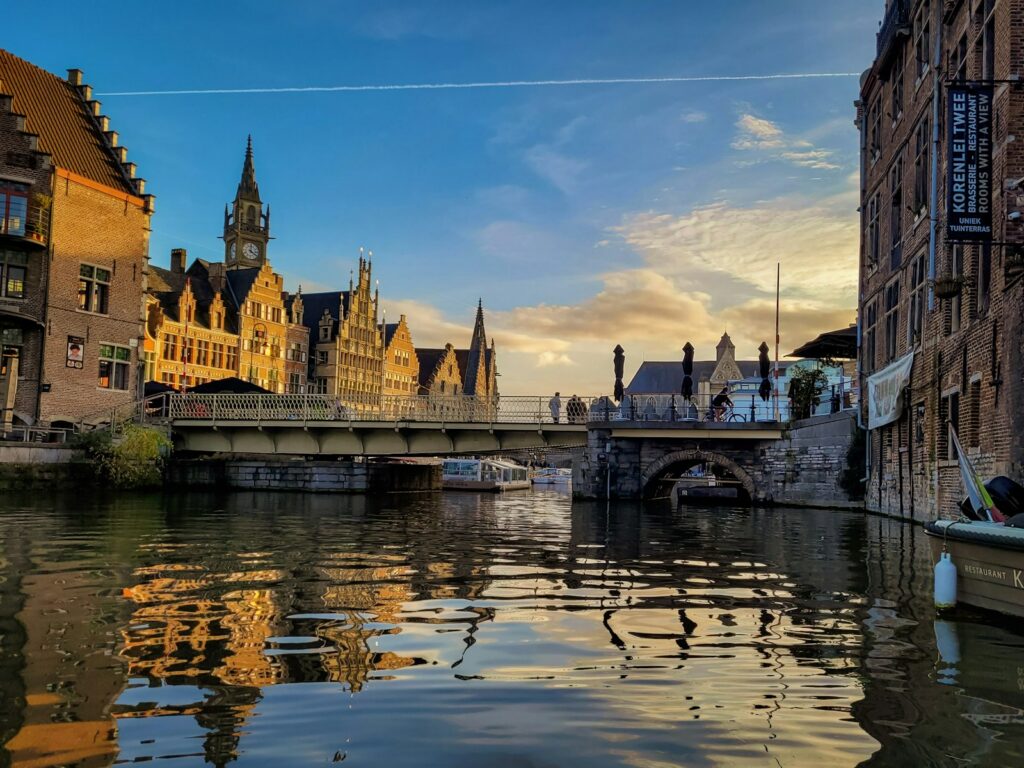
Torn between Ghent and Bruges? The short answer: you don’t have to choose. A direct train takes you from one city to the other in 28 minutes on average, and there are 93 trains a day. Bruges is compact and fairytale-like. Ghent is bigger, livelier and feels more like a city where people actually live. If you want to see both, stay in Ghent and visit Bruges as a day trip.
In all honesty: Chambreplus is in Ghent, so we are not entirely neutral. That’s why we stick to facts and figures below.
Ghent and Bruges at a glance
| Ghent | Bruges | |
|---|---|---|
| Population (1 January 2026) | 275,475 | 120,900 |
| Character | Medieval centre in a lively student city | Compact historic centre with canals |
| World Heritage | The Belfry with the Cloth Hall (1999) and two béguinages: the Little Béguinage and the Béguinage of Sint-Amandsberg (1998) | The entire historic centre (2000) and the Béguinage (1998) |
| Best-known sights | Gravensteen castle, Graslei and Korenlei, St Bavo’s Cathedral with the Ghent Altarpiece, Patershol | Market Square with the Belfry, the canals, the Béguinage, the Church of Our Lady |
Why Bruges?
- The whole centre is World Heritage. UNESCO listed the historic centre of Bruges in 2000. Every corner looks like a postcard.
- Compact: the best-known sights are close together, ideal for a day out.
- The canals define the look of the city.
Good to know: Bruges is hugely popular with day trippers. In 2024 the city counted almost 6.9 million day visitors, for 120,900 residents. The city council even wants to slow day tourism down a little. During the day, the centre is often busy.
Why Ghent?
- A real city with a medieval heart. With more than 275,000 residents and Ghent University, Ghent is a living city well beyond its famous sights.
- Big names within walking distance: Gravensteen castle, the Graslei and Korenlei, the Belfry and St Bavo’s Cathedral with the Ghent Altarpiece by the Van Eyck brothers. Find more highlights on Location & Ghent.
- World Heritage too: the Belfry with the Cloth Hall, and two béguinages, the Little Béguinage and the Béguinage of Sint-Amandsberg.
- Food and drink: from breakfast to dinner, the centre is full of good places. Have a look at our favourites.
- In December: the Gentse Winterfeesten turn the city centre into one big Christmas market. Read our guide to the Ghent Christmas market.
Can you visit Ghent and Bruges in one day?
You can, as the train only takes 28 minutes. But we wouldn’t recommend it if you really want to see both cities: you end up rushing from one highlight to the next. Plan at least one full day per city, or stay in Ghent and take the train to Bruges for a day. For Ghent itself, we put together a 2-day itinerary.
How to combine Ghent and Bruges
- Stay in Ghent. You have plenty of choice for dinner in the evening, and you wake up in the middle of the old town.
- Take the train to Bruges. In Ghent, trains leave from Gent-Sint-Pieters, Gent-Dampoort and Gentbrugge. From Chambreplus it is about a 15-minute walk to Gent-Dampoort, see how to get here.
- Check the timetable in the SNCB app or on the SNCB website. Engineering works can change journey times.
- Come back to Ghent in the evening. When you see the towers lit up after a day in Bruges, you’ll know why you stayed here.
Stay in Ghent at Chambreplus
Chambreplus is on the Hoogpoort, one of the oldest streets in Ghent. Gravensteen castle, the Korenmarkt and the Belfry are a few minutes’ walk away.
- Four rooms, each with its own character, for two guests, from €138 per night. View the rooms.
- Check-in is from 14.00. Arriving earlier? Leave your luggage safely with us.
- By train: get off at Gent-Dampoort (about a 15-minute walk) or take tram 1 from Gent-Sint-Pieters to the Korenmarkt. More on our practical info page.
Frequently asked questions about Ghent and Bruges
What’s prettier, Ghent or Bruges?
It depends on what you’re looking for. Bruges is compact and its entire historic centre is World Heritage, but it is busy with day trippers. Ghent has an equally rich medieval centre, including the Belfry and two béguinages on the World Heritage List, in a bigger, livelier city.
How far is Bruges from Ghent?
According to SNCB, the direct train takes 28 minutes on average, with 93 trains a day between the two cities.
Can you visit Ghent and Bruges in one day?
You can, but you will have to rush. Plan at least one full day per city.
Is Ghent bigger than Bruges?
Yes. On 1 January 2026 Ghent had 275,475 residents and Bruges 120,900.
Where should you stay to see both Ghent and Bruges?
In Ghent. Bruges is a short train ride away, and in the evening you are in a lively city with plenty of places to eat.